

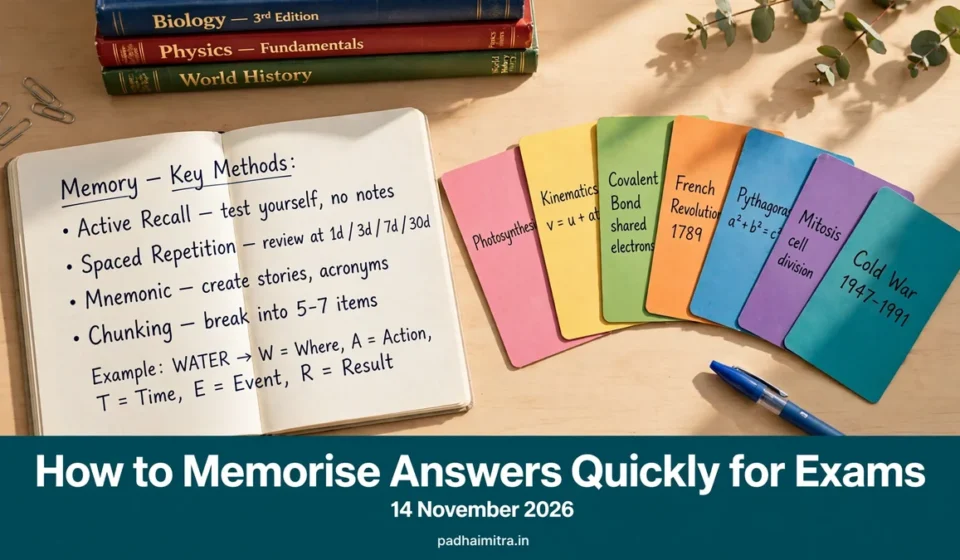

How to memorise answers quickly for exams is simple when you stop re-reading the same page again and again. Read it once to understand it, break it into small chunks, turn each chunk into a keyword, say it back in your own words, and write it once from memory. One round takes about 30 minutes for a long answer — far better than reading the same lines ten times. This article shows you six techniques, a worked example, and a 30-minute routine you can use tonight.
Follow them in order, and you will know how to memorise answers quickly for exams the same night you learn them.
First, Understand the Answer Before You Memorise It
Memorising without understanding is the slowest way to learn. When you do not know what a line means, your brain treats it as random words, and random words slip away fast. When you know what it means, the words stick to the idea.
Before you memorise any answer, read it once slowly and ask: what is this answer about, why does this point come after the previous one, and can I explain it in one simple sentence? If you cannot, go back to the chapter first — read it in your NCERT textbook first. Ten minutes of understanding saves thirty minutes of blind repetition.
Take a history answer on the Non-Cooperation Movement. If you know it started because people were angry about the Jallianwala Bagh massacre and the Rowlatt Act, the points follow a story. If you do not, they look like a random list of dates and names. Meaning comes first, memory follows.
Break Long Answers into Small Chunks
Long answers feel impossible only because you try to swallow them whole. The fix is chunking: split the answer into pieces of two or three points, and learn one piece at a time.
How to memorise long answers quickly with chunking:
- Count the points — a 10-mark answer usually has five to seven.
- Group them into chunks of two or three related points. Give each chunk a small label, like "causes", "events", "results".
- Learn chunk one, cover it, and say it from memory. Then learn chunk two the same way.
- Join the chunks: say chunk one, then chunk two, then both together.
A five-point answer becomes three small jobs instead of one big one, and finishing each one keeps you going. This is one of the oldest memorisation techniques for exams — your brain holds a few items easily and drops a long list.
Also read: One Month Revision Plan for Board Exam Class 10: A 4-Week Plan
Use Keywords and the First-Letter Method
You do not need to remember every word of an answer. You need to remember the points, and for each point, one keyword that brings the whole line back.
Read one point and pick its most important word. For a science answer on photosynthesis, the keywords might be "sunlight", "chlorophyll", "carbon dioxide", "oxygen" — four words standing for four lines. Say them in order a few times, and the full lines start coming back on their own.
The first-letter method takes this one step further: take the first letter of each keyword and make a silly sentence from them. For the photosynthesis keywords, S-C-C-O could become "Sun Comes, Clouds Out" — and strange sentences are easy to remember. In the exam hall, one silly sentence can unlock four points.
Use this trick where the points have no natural order and you keep forgetting one in the middle — not for every answer.
Keep the keyword list short — five or six words are enough. Once you can say those five words in order, you will see how to memorise answers quickly for exams is really about remembering five words, not five pages.
Teach It Back, Then Write It from Memory
The fastest test of memory is teaching. After reading an answer, close the book and explain it out loud as if a friend asked you, in your own words. If you get stuck, open the book, check that one part, close it again, and continue.
Teaching forces your brain to fetch the answer instead of just recognising it on the page. Recognising feels like knowing, but it is not — many students feel "I know this", then go blank in the exam because they never practised fetching it. You do not need a real listener — a wall, a pillow, or a voice note on your phone works. Record yourself once and listen to it later; the places where you pause or mumble are the parts you have not learned yet.
Writing is the strongest check: take a blank page, write the full answer from memory, then open the book and compare. Tick the points you got right and circle the ones you missed. Most students find the parts they thought they knew are half-right or missing a key word — now you know exactly what to fix, instead of re-reading the whole answer. Write only the missed parts two or three times, then repeat the full write-up once more — two rounds are usually enough.
| Technique | Best for | Time per answer | Why it works |
|---|---|---|---|
| Chunking | Long answers, lists of points | 10–15 minutes | Small pieces are easier to hold than one long list |
| Keywords + first letters | Steps, lists, definitions | 5–10 minutes | One word unlocks a whole line |
| Teach-back | Any answer you half-know | 5 minutes | Speaking forces your brain to fetch, not just recognise |
| Writing from memory | Final check before the exam | 10 minutes | Shows exactly which parts are weak |
| Short revision loops | Keeping answers fresh | 5 minutes per loop | Quick repeats beat one long re-read |

Use Short Revision Loops
One long session is weaker than three short ones — your brain keeps more when it meets the same answer again after a small gap. That is why a 30-minute plan with built-in repeats beats two hours of reading.
A 30-minute memorisation routine for one long answer:
| Time | What to do |
|---|---|
| 0–5 min | Read the answer once to understand it; mark the keywords |
| 5–15 min | Chunk it; learn chunk by chunk, saying each from memory |
| 15–20 min | Teach it back out loud in your own words |
| 20–25 min | Write it once from memory; compare with the book |
| 25–30 min | Fix only the missed parts; say the keywords once more |
Then leave it. Come back after one hour and say the keywords once more — that takes two minutes. Come back the next morning and write the first two lines from memory. These tiny loops are what move an answer from "learned today" into "still there in the exam". That is how to memorise answers quickly for exams and still have the answer ready on exam day. If you want how to learn answers quickly before exam day without panic, this routine is the whole plan: learn it properly once, then touch it briefly, twice.
Also read: What to Study the Night Before an Exam: A Simple 3-Hour Plan
A Worked Example: Memorising a Science Answer
Here is the full method on one real answer. The question: "What is photosynthesis, and why is it important?"
The textbook answer, in short: "Photosynthesis is the process by which green plants make their own food using sunlight, water and carbon dioxide in the presence of chlorophyll. Oxygen is released as a by-product. It is important because it produces food for plants and oxygen for all living beings."
Step 1 — Understand it. The idea is simple: plants cook their own food with sunlight, and oxygen comes out as a side product.
Step 2 — Chunk it. Chunk one: the definition (plants make food, sunlight, water, carbon dioxide, chlorophyll). Chunk two: oxygen released. Chunk three: why it matters (food + oxygen).
Step 3 — Keywords. Definition chunk: "sunlight, water, carbon dioxide, chlorophyll". First letters: S-W-C-C. Make a sentence: "Sunny Water Cools the Classroom." Silly, but you will remember it.
Step 4 — Teach it back. Close the book: "Photosynthesis is how green plants make food. They use sunlight, water and carbon dioxide, and chlorophyll helps. Oxygen comes out. It matters because plants get food and we get oxygen." That is the whole answer in your own words.
Step 5 — Write it from memory. Write it once, compare, fix the missed word — most students forget "chlorophyll" on the first try. That is the one word to repeat.
Once you see how to memorise answers quickly for exams with these five steps, repeat them on a history answer, a civics definition, or a long English answer — the subject changes, the method does not.
Common Mistakes That Slow You Down
Reading the same page ten times. Re-reading feels productive, but it only builds recognition. After the second read, switch to saying or writing it from memory. If you are searching for how to memorize answers fast for exam season, this one change — replacing re-reading with recall — saves the most time.
Learning everything the night before. A brand-new long answer learned at midnight is half-gone by morning. Learn the hard answers two or three days early; use the last night only for short revision loops.
Skipping the first line. In the exam, the first line is the hardest to start. Practise the opening line separately — say it three times on its own. Once the first line is out, the rest follows.
Memorising the exact book language. Board answers are marked on points, not on copying the textbook word for word. Learn the points and keywords, and write in clear, simple sentences of your own — your own words come back more easily under pressure, which is how to remember answers in exam.
Studying with the phone in reach. One notification breaks the loop and you start the chunk again from zero. Keep the phone in another room for the 30-minute routine — thirty focused minutes beat two distracted hours.
Conclusion: How to memorise answers quickly for exams comes down to five habits: understand the answer first, break it into small chunks, remember it through keywords, teach it back in your own words, and write it once from memory. Add short revision loops — one hour later, next morning — and the answer stays with you till the exam. Start with one answer tonight, use the 30-minute routine, and see how much of it you can write tomorrow without looking.
Frequently Asked Questions
Q: How many times should I read an answer before memorising it?
A: Read it once to understand it, and a second time to mark keywords. After that, stop reading and switch to recall — saying it, teaching it, or writing it from memory.
Q: How to memorise answers quickly for exams when only one day is left?
A: Pick the most important answers first — the ones your teacher marked or that came in previous papers. Use the 30-minute routine for each, then do a two-minute keyword repeat after one hour. Do not start a brand-new long answer late at night; revise the ones you half-know.
Q: Can I memorise long answers without writing them?
A: You can, but writing is the most reliable check. If you truly cannot write, say the answer out loud from memory and record it — speaking still forces recall, while silent re-reading does not.
Q: Why do I forget answers in the exam even after learning them at home?
A: Usually because you only recognised the answer on the page and never practised fetching it under pressure. Practise writing answers from memory with a timer, and practise the opening line separately. Only recall practice closes the gap between "I know this" and "I can write this".
Q: Is it okay to write answers in my own words in the board exam?
A: Yes. Marks are given for the correct points, clear structure, and neat presentation — not for copying textbook sentences word for word. Learn the points and keywords, then write them in simple sentences of your own.