


One month is left before the board exam, and the whole syllabus feels like a mountain. Every subject looks unfinished, and every day starts with the same question — what should I study today?
A one month revision plan for board exam class 10 does not start with studying harder. It starts with one day of audit: finding out which chapters are strong, which are half-ready, and which are weak. Once that list is on paper, the month stops feeling like a mountain.
This guide is a last month revision plan for board exam students. It shows how to revise in one month before board exam season: the audit method, a week-by-week plan, a sample daily routine, subject-wise differences, and a simple way to analyse mock tests.
What Revision Actually Means
Revision does not mean reading the whole book again. It means taking what you have already studied, making it firm in your memory, fixing your mistakes, and practising writing it in exam form.
If you have read a chapter once, its main points, formulas, definitions and your notes are enough. A chapter you have never read at all needs a different approach: its basic points and the previous year question pattern, not a full fresh reading.
So the rule for this month is simple: revise what you know, repair what is weak, and do not open a new chapter in the last week.
Step 1: Give One Day to the Audit, Not to Studying
Before making a plan, give one day — or at least 2 to 3 hours — only to the audit. Do not study that day. Audit only.
Take a copy or a page. For each subject, write down its chapters. Against every chapter, put one of three marks: Pakka, Aadha Pakka, or Kamzor.
- Pakka means you can solve that chapter’s questions without looking at the book.
- Aadha Pakka means you understand the concept but get stuck while writing the answer.
- Kamzor means the concept itself is not clear, or the chapter scares you.
Worked example: 5 subjects, 10 chapters each — 50 chapters. If 20 are Pakka, 20 are Aadha Pakka and 10 are Kamzor, the real work is only those 10 weak chapters; the other 40 need revision only.
Put this list on the wall or on the first page of your copy, and tick each chapter as you finish it.
| Audit mark | What it means | What to do with it |
|---|---|---|
| Pakka | You can solve questions without the book | Revise from notes only, in week 3 |
| Aadha Pakka | Concept is clear, writing gets stuck | Practise writing answers, in week 2 |
| Kamzor | Concept is not clear, or the chapter scares you | Study first, in week 1, with basics + examples |
Do the audit subject by subject — for Class 10, Maths, Science, SST, English and your second language; for Class 12, your stream subjects.
The One Month Revision Plan for Board Exam Class 10 — Week by Week
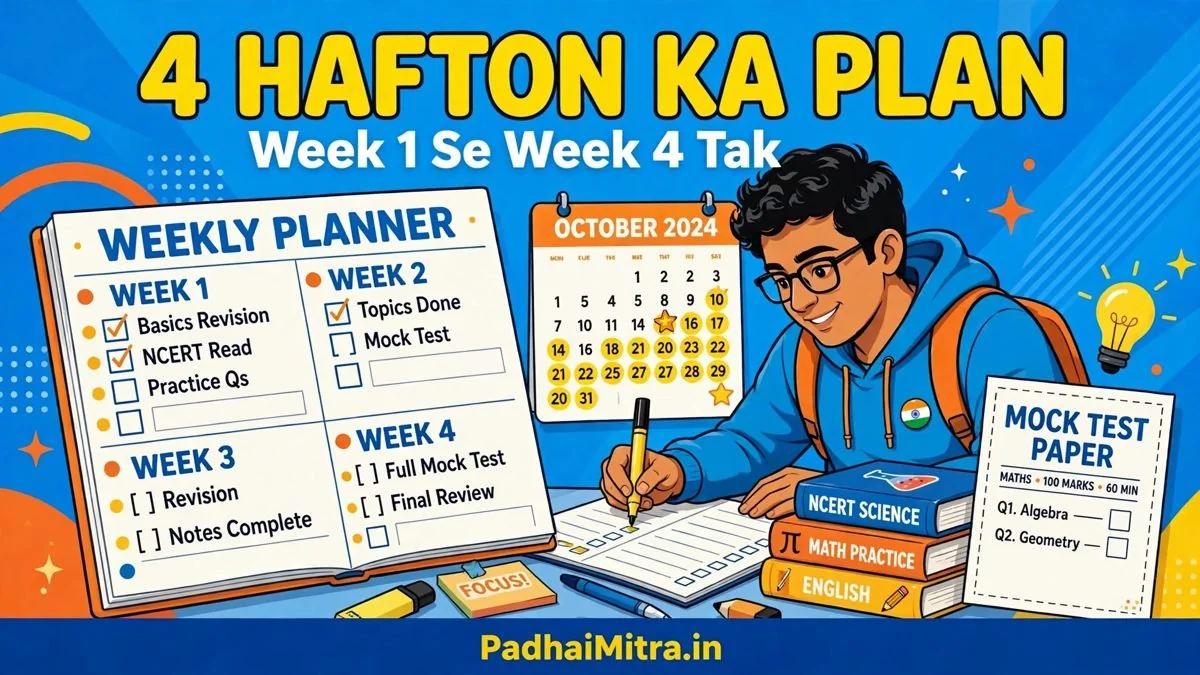
This is the core of the plan: weak chapters first, then practice, then a full revision round, and a light final week. Follow this board exam revision plan week by week in the same order — do not change the order of the weeks.
| Week | Main work | Daily focus |
|---|---|---|
| Week 1 (Days 1–7) | Weak chapters first, make notes | 2 subjects a day: 1 hard + 1 easy; after each chapter, write a summary in your own words |
| Week 2 (Days 8–14) | Practice and tests, mistake diary | 1 small test every day; write every wrong answer in the mistake diary |
| Week 3 (Days 15–21) | Full revision round, 1-page summary | Only notes, highlights and the mistake diary; 1-page summary per subject |
| Week 4 (Days 22–30) | Light revision, mock test, rest | Do not start a new chapter; summaries + mock test + sleep on time |
Week 1 — weak chapters first. Study the hard subject in the morning, when your mind is fresh. After reading a chapter, close the book and write its main points in 10 minutes. In this week, start looking at previous year questions — not to memorise them, but to see which type of questions repeat and which chapters carry more marks.
Week 2 — write and test. In the exam, remembering is not enough — you must also write correctly and on time. Take at least one small test every day, even if it is only 10 questions. After the test, write every mistake in a separate copy — your mistake diary. Do not write only that the answer was wrong. Write why: was the concept unclear, was the calculation wrong, did you read the question wrong, or did you run out of time?
Week 3 — the full revision round. Do not open the full book this week. Look only at your notes, highlights and mistake diary. Make a 1-page summary for each subject: important formulas, dates, definitions, one or two examples, and the points you keep forgetting. That single page is what you will read the day before the exam.
Week 4 — the light week. This is the week where most students make the biggest mistake: they start something new, or they stay up all night. Do not start a new chapter in the last week. Look at summaries only, take 1–2 mock tests, read the mistake diary again, and sleep on time.
A Sample Daily Routine for a School Student
Every student’s timings are different, but a sample routine gives you the shape. Suppose school is from 8 AM to 2 PM. This table is a sample routine — change it to fit your school and tuition timings. It is an example, not a rule for every student.
| Time | What to do |
|---|---|
| 4:00 – 6:00 PM | First study session: hard subject (for example, Maths formulas + 10 sums) |
| 6:00 – 6:30 PM | Break — walk, snack; do not open reels or games |
| 6:30 – 8:00 PM | Second session: easy subject or revision (for example, SST timeline + notes) |
| After dinner | 30 minutes: write what you finished today, what is pending, what to do tomorrow |
Study for 50 minutes, then take a 10-minute break. In the break, drink water or walk a little. Keep the phone in another room or on silent during study time. If you must use the phone for notes or a video, open only that one app, turn notifications off, and close it when the work is done.
Revise Each Subject Differently
Every subject needs a different kind of revision. Using the same method for all of them helps one subject and hurts another.
Maths: Formulas plus solved examples. Only reading theory is not enough. Write the trigonometry identities — sin²θ + cos²θ = 1 — then solve two questions that use them.
Science: Diagrams, their labels, steps and definitions. In Photosynthesis, draw the diagram once from memory, label it, and write the word equation in your own words.
Social Science: Dates and events in a timeline. In Nationalism in India, write 5 dates in order and one line about each, then practise writing answers in points.
Languages: Summaries of important chapters, character names, and important points or quotes. Read the summary, then close the book and write the chapter’s main idea in 4–5 lines.
How to Analyse a Mock Test
Giving a mock test is easy. Analysing it is the real work. After the test, divide your answers into three groups: right answers, wrong answers, and skipped answers.
For wrong answers, write the reason in the mistake diary — concept, calculation, misread question, or less time. For skipped ones, write whether time ran out or the concept was missing. Before the next test, revise only the topics that were wrong or skipped.
Also read: A full method for turning mistakes into improvement is in How to Improve After a Mock Test.
Mistakes That Break the Plan
Most students know these mistakes and still make them. Drop even one or two.
Giving one subject the whole day. The others fall behind, and their pressure explodes in the last week. Two subjects a day — one hard, one easy — keeps all of them moving.
Comparing your preparation with friends. A friend says they finished the whole syllabus, and you panic — but you do not know how firm their “finished” really is.
Cutting sleep at night. Less sleep means less focus the next day, and even what you studied does not stay in memory.
Dropping the whole plan because one day went wrong. If one day fails, start again the next day. One bad day does not spoil the month; quitting does.
The Last Day and the Exam Hall Checklist
The day before the exam, look only at your formula sheet and 1-page summaries. Keep your admit card, pens, pencil and scale ready the night before. Sleep early.
In the exam hall, spend the first 2 minutes reading the paper. Start with the easy questions. Leave a hard question and come back later. Write answers in points and save the last 5 minutes to check your paper.
Also read: The night before the exam has its own 3-hour plan — read What to Study the Night Before an Exam.
Conclusion
A one-month revision plan is not about more hours. It is about four things: audit first, weak chapters first, one small test every day, and summaries only in the last week. Make your audit list today and start tomorrow.
Also read: If starting itself feels hard, read How to Focus on Studies When You Don’t Feel Like Studying and How to Study Effectively for Exams.
FAQs
Q: How to revise full syllabus in one month — is it really possible?
A: Yes, if you follow the audit method — weak chapters first, one small test every day, and revision from notes and summaries instead of re-reading the whole book. For a chapter you never read at all, look at its basic points and the previous year question pattern only.
Q: How many hours should I study every day in the last month?
A: Focus matters more than hours. After school, 3 to 4 hours of focused study without distraction is usually enough. Do not spoil your health and sleep to add hours.
Q: When and how many mock tests should I give?
A: From the second week, 2 to 3 small tests per week. In the third week, subject-wise tests. In the last week, 1 to 2 full mock tests. After every test, analyse your mistakes in the diary.
Q: What if I miss 2–3 days of study in the middle of the month?
A: Start the plan again; do not throw it away. Put only the important missed chapters back into the schedule and keep the rest of the plan as it is. One bad stretch of days does not spoil the month — quitting does.
Q: My school and tuition take the whole day. How do I fit this 30 day revision plan for class 10 board exam into my routine?
A: Use the sample routine in this article as a shape, not a fixed timetable. If school ends later, move the evening blocks later. If you have no tuition on a day, use that slot for self-study.



-
-
-
-
-
-
Show Comments[…] Also read: How to Revise in One Month Before Board Exam: A 4-Week Plan […]
[…] I forget.” Often the reason is simple — the chapter was read once and never revised. Use a spaced repetition study plan: revise your notes tonight for 10 minutes, again after 3 days for 7 minutes, once more after a week […]
[…] checklist is a small plan that saves you from the morning rush. The time for new topics was in your one-month revision plan — the morning of the exam is not the time to start […]
[…] your list of weak chapters from the results. For the final month, use the 4-week revision plan in One Month Revision Plan for Board Exam Class 10: A 4-Week Plan — written for class 10, but the shape (audit, subject cycles, full papers) fits class 12 too. A […]
[…] Also read: One Month Revision Plan for Board Exam Class 10: A 4-Week Plan […]
[…] Also read: One Month Revision Plan for Board Exam Class 10: A 4-Week Plan […]