



What to do when your mind goes blank in an exam is simple: stop for 30 seconds, breathe slowly, skip that question, and start with an easy one. Then come back to the hard question after a few minutes. Stress can make it hard to recall something you studied, even when you know it. Calming down for a short while may help the answer come back — it does not always happen, but it happens often enough that the pause is worth taking.
Imagine this. You are sitting in the exam hall. You read the first question — and your mind goes empty. You studied this last night. Now you cannot remember a single line. Your heart is beating fast, and one thought keeps repeating: “I am going to fail.”
If this has happened to you, know this first: it does not happen only to you. It happens to strong students too. What helps is not forcing yourself harder. What helps is pausing, moving to an easy question, and coming back — instead of staying stuck on one question while the paper slips away.
Why Does Your Mind Go Blank in an Exam?
A blank mind does not mean you did not study. It means there is too much pressure at that moment. When you panic, your attention moves from the question to the fear itself — “Will I fail?” That makes it hard to recall what you studied. It is like finding something in a dark cupboard: you need a little light, not more pushing.
Stress can block recall for a short time. When the stress eases a little, the answer may come back. Sometimes it does not come back fully, and then the best move is to write what you do remember and move on.
What to Do in the First 30 Seconds
When your mind goes blank, do this at once. Do not write anything yet.
- Put your pen down. Rest both hands in your lap.
- Close your eyes. Take one slow, deep breath in. Let it out slowly. Do this twice.
- Say quietly to yourself: “This is only panic. I will come back to this question.”
These 30 seconds are not wasted. Many students write anything at once, write a wrong answer, and panic more. Stopping and breathing first is the right start.
Skip the Question and Start With Easy Ones
This is the most important rule in this article: do not sit stuck on one question.
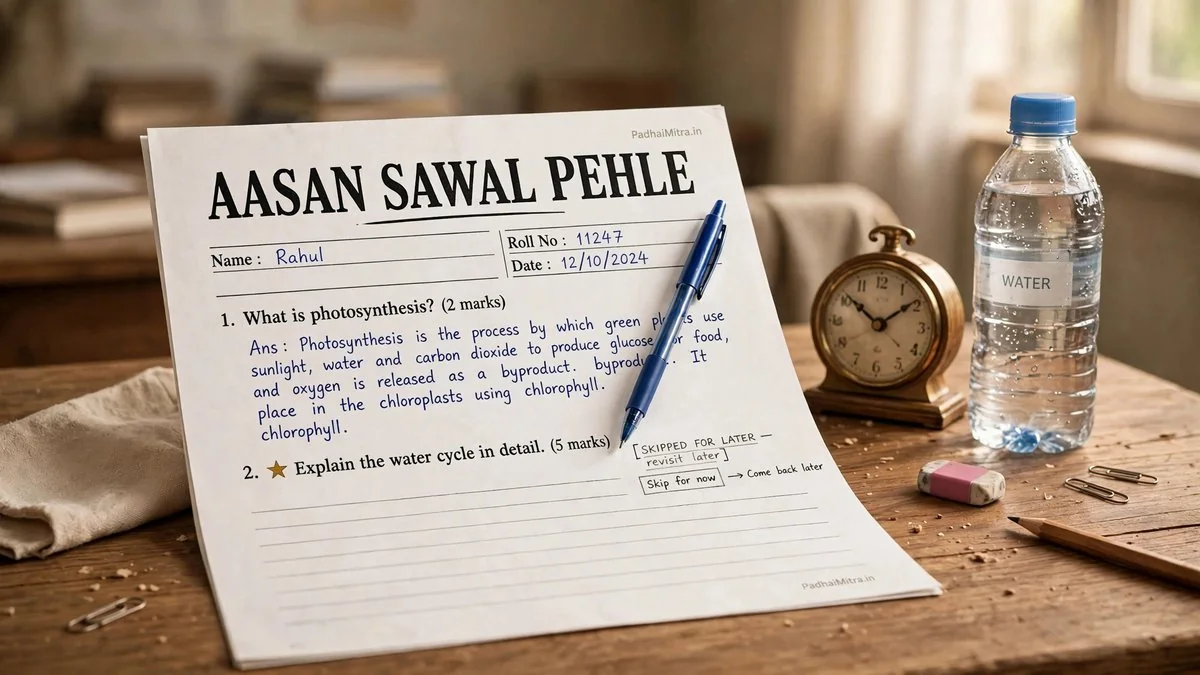
- Put a small star next to the question you skipped, so you can find it again later.
- Move ahead and do the questions you know.
- Easy questions help in two ways. First, you keep writing answers and collecting marks for what you know. Second, finishing a few questions can help you feel steadier, and the panic often eases a little.
- Sometimes, while you solve an easy question, the answer to the hard one comes to mind. That may happen — it is not something to count on, but it is one more reason not to stay stuck.
Changing the order of questions is not a mistake. You can come back to a skipped question at the end. But sitting on one question and leaving the whole paper is the biggest mistake in an exam.
A flexible suggestion, not a rule: if a question does not start after about two minutes of trying, mark it and move on. This is only a guide to help you decide — always follow your own paper’s instructions and marking requirements. Some papers have their own order or rules, and those come first.
Small Ways to Recall the Answer
When you come back, try these steps one at a time.
Read the question again, slowly
Read it word by word. Often the question itself gives a hint — a word, a date, a name. If the question asks about the “effects” of something, that word tells you the answer needs points about what changed, not only a definition.
Start from the first point
Try to remember only the first word or the first point of the answer. Once the first point comes, the next points may follow. Try to remember how the page looked — the heading, the diagram, the example your teacher gave in class.
Remember an example or a diagram
Think of the example connected to the topic. One small memory can pull the rest of the answer with it.
Example 1 — Science: you forget the definition of photosynthesis. Do not repeat the word in your head. Think: green leaf, sunlight, water, carbon dioxide, oxygen. Write those five words down and build one or two simple lines around them.
Example 2 — Maths: you forget how to solve a question. Do not try to see the whole solution at once. Recall only the first step — for a quadratic equation question, write the formula first, then put the values in. The next step may follow from there.
Example 3 — History: you forget the points about an event. Recall one date or one thing linked to the question — for example, if the question is about the Non-Cooperation Movement, start with 1920 and what happened just before it — then build the answer around that one point.
Write what you remember, even if it is only half
If you remember only half the answer, write that half — the formula, the first point, or the example. Then move on. You can add more later if it comes back. Never leave a question fully blank before you have written everything you know about it. A half-correct answer can still get marks. A blank answer gets none.
How to Stay Calm in the Exam Hall
Panic does not disappear fully in the exam hall. But you can keep it low.
- Reach on time. Reaching late raises panic before the paper even starts.
- Look at the whole paper first. Seeing which questions you know gives your mind confidence.
- Keep your water bottle near you. One sip also gives your mind a short break.
- Do not compare yourself with others. How fast someone else writes has nothing to do with your marks.
- Do not check the clock every minute. Once every 15 to 20 minutes is enough.
These habits help you stay steadier through the three hours.
If panic happens in almost every exam and affects your sleep or daily life, talk to a parent, a teacher, or your school counsellor. This article gives general exam tips only — it is not medical advice.
The Night Before: Preparation That Prevents a Blank Mind
A blank mind does not start in the exam hall. It often starts the night before.
- Do not start a new topic the night before. It confuses your mind and makes old topics feel weak.
- Look only at your short notes — main points and formulas.
- Pack your bag the night before: pens, admit card, water bottle.
- Sleep well. A tired mind finds it harder to recall answers, and a blank mind becomes more likely. Sleep is part of preparation.
If the Whole Paper Feels Hard
Sometimes the whole paper feels hard. The same rule works: stop, breathe, and start with the easy ones.
- Read all the questions once, and mark the ones you know.
- Do the easiest questions first, even if they are at the end of the paper.
- In every question, write what you know — a point, an example, a formula.
- Keep time at the end for the questions you skipped (see the plan below).
Start with what you know, and work through the paper in that order. That is the practical thing to do when a paper feels hard.
A Sample Exam Plan You Can Follow
This is a sample plan for a 3-hour (180-minute) paper. It adds up exactly: 15 + 140 + 10 + 15 = 180 minutes. It assumes your paper gives 15 minutes of reading time, as many board papers do. If your paper does not give separate reading time, use the first 15 minutes of writing time to read and mark the paper, and shorten the answering block by the same amount. Always follow your own paper’s instructions and timings — this plan is a guide, not a rule. The 30-second reset is not a separate slot: use it inside the answering block whenever your mind goes blank.
| Time (from start) | Minutes | What to do |
|---|---|---|
| 0:00–0:15 | 15 | Reading time: read the whole paper, mark the easy questions with a tick and the hard ones with a star. Do not write answers yet. |
| 0:15–2:35 | 140 | Answering: do the easy questions first, in any order. Skip hard ones with a star mark. If your mind goes blank, take the 30-second reset, then move to the next easy question. |
| 2:35–2:45 | 10 | Revisiting: go back to the starred questions. Write what you remember, even if it is only part of an answer. |
| 2:45–3:00 | 15 | Final check: read your answers, fill in anything you left out, check question numbers, and make sure no question is blank without a try. |
| Total | 180 |
This plan only changes the order — easy first, hard later. That one change protects you from staying stuck on one question.
After the Exam: Do Not Blame Yourself
If one question stayed blank, do not keep thinking about it for hours after the exam. At home, ask one thing only: when did your mind go blank, and what will you do differently next time? Then move on. A blank mind is not weakness.
Conclusion
What to do when your mind goes blank in an exam: give the panic 30 seconds, breathe slowly, skip that question, do an easy one, and come back later. Try small recall steps — read the question again, start from the first point, remember an example or a diagram — and write what you know instead of leaving the page blank.
Stress can make recall hard for a short time, and calming down may help the answer return. That short pause can help you get back into the paper instead of losing the whole paper to one question.
FAQs
Q: What to do when your mind goes blank in an exam on the very first question?
A: Do not sit on it. Mark it with a star, breathe for 30 seconds, and do an easy question first. Confidence comes back, and the first answer may come back later too.
Q: What should I do if I forget an answer in the exam?
A: Read the question again slowly, remember the first point or an example, and write what you remember. A half-correct answer is better than a blank one.
Q: How can I stay calm in the exam hall?
A: Reach on time, read the whole paper first, keep water near you, do not compare yourself with others, and check the clock only once every 15–20 minutes.
Q: What should I study the night before the exam?
A: No new topic. Only short notes, main points, and formulas. Pack your bag and sleep well.
Q: What should I do if the whole paper feels hard?
A: Read all the questions, mark the ones you know, and do the easiest ones first. Write what you know in every question, and keep the last 10 minutes for skipped questions and the final 15 minutes for checking.



[…] Also read: Exam me blank mind kaise handle kare […]
[…] Also read: Exam me blank mind kaise handle kare […]
[…] Questions left blank because time ran out are also the questions where your mind goes blank under pressure. If that happens to you in the hall, read this: What to Do When Your Mind Goes Blank in an Exam. […]