

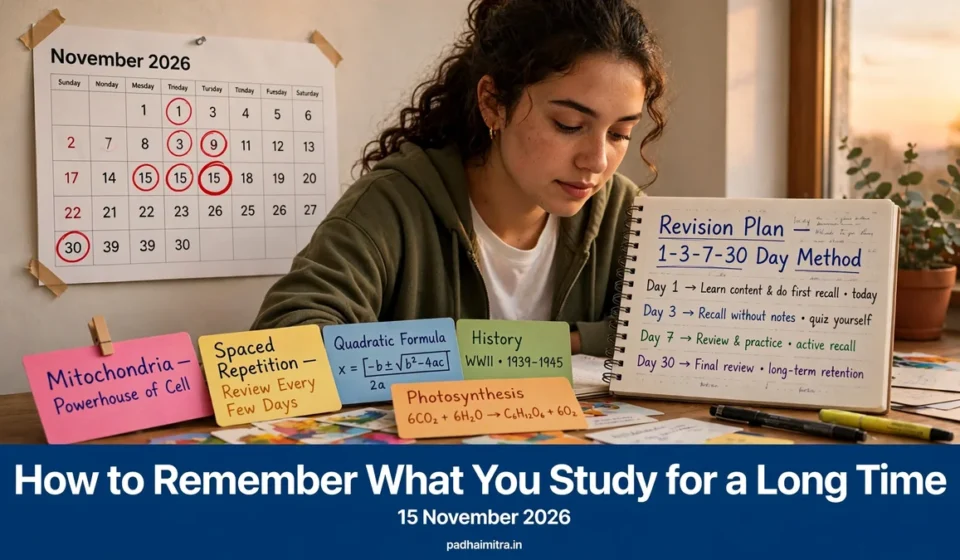

How to remember what you study for a long time comes down to one habit: revisiting each chapter on a fixed schedule instead of reading it once and hoping it stays. Most students forget not because their memory is weak, but because they read a chapter in October, never touch it again, and expect it to be there in February. It will not be. Memory fades when it is not used, and stays when recalled again at the right gaps.
This guide gives you a simple system: spaced repetition, active recall, a weekly revision cycle, and sleep. No new app, no extra hours.
Follow it for a month, and you will know how to remember what you study for a long time without studying longer hours.
Why You Forget Most of What You Study
Forgetting is not a fault in your brain; it is how the brain works. It keeps what you use again and again, and drops what you touched only once. That is why a chapter feels fully known the evening you read it and half-gone a week later.
Re-reading makes this worse, because it feels like learning. The page looks familiar, so you think you know it — but recognition is not memory. In the exam you have to produce the answer from nothing. The only way to know if something is really in your memory is to close the book and try to say it or write it without looking. If you cannot, it was only recognised, never stored.
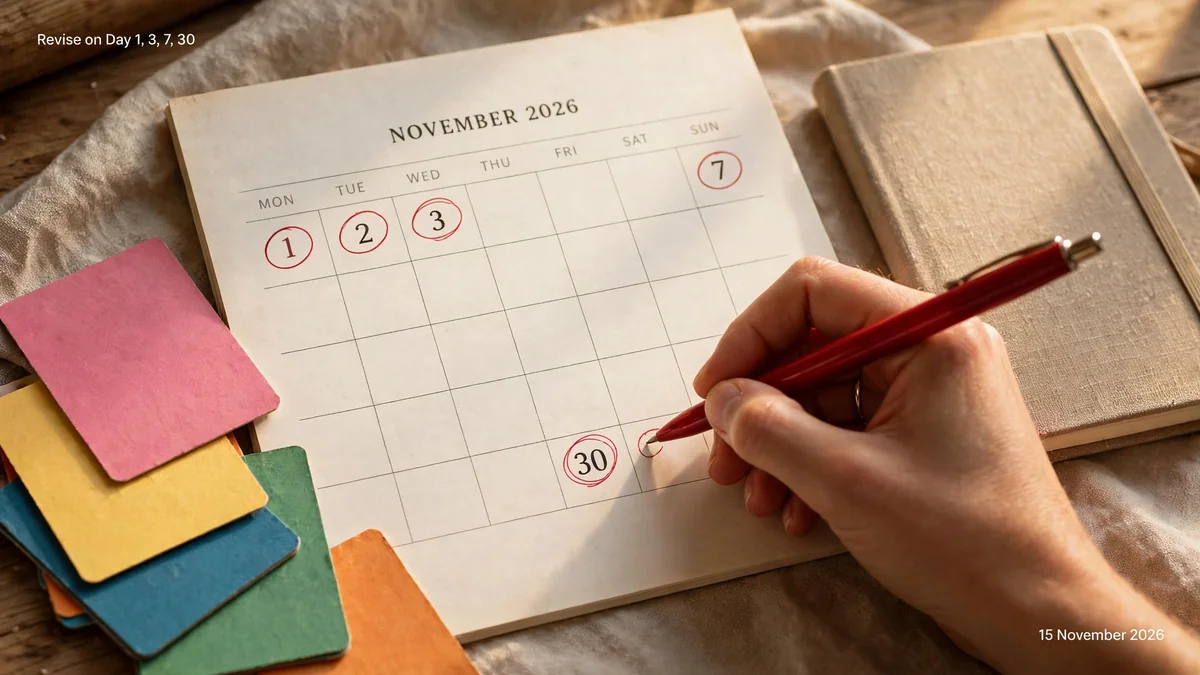
The fix is not more hours. It is touching each chapter again at a few fixed points — the same evening, after a few days, after a week, and once more after a month. Each touch takes only a few minutes, and makes the memory last much longer.
How to Remember What You Study for a Long Time with Spaced Repetition
Spaced repetition is the core of this system. Instead of revising a chapter ten times in one day, you revise it a few times with growing gaps. The gaps are what make it stick: each time you recall something just as it starts to fade, your brain stores it more strongly.
Here is a simple cycle that works for school chapters. It is the most useful of all the long term memory techniques for students, because it needs no tool and fits around school:
| When | What to do | How long |
|---|---|---|
| Same evening | Close the book and recall the main points; write them in 5–6 lines | 10 minutes |
| After 3 days | Recall again from memory; re-read only the parts you missed | 10 minutes |
| After 7 days | Say the chapter’s key points aloud; solve 2–3 questions on it | 15 minutes |
| After 30 days | One quick read of your short notes + one written answer | 15 minutes |
Take a real example. You study the Class 10 Science chapter Light on a Monday. Monday evening, you close the book and write down the main points: reflection, refraction, mirror formula, lens formula, ray diagrams. Thursday, you recall the list and check what you forgot. Next Monday, you say the points aloud and solve two numericals. A month later, you read your notes and write one answer. Four short touches, about 50 minutes across a month — and the chapter is still there in February. That is spaced repetition for board exam preparation in its simplest form: small repeats, growing gaps, no cramming.
The gaps matter more than the number of repeats. Five revisions on the same day feel thorough, but by next week most of it is gone. The same five touches spread over a month keep it. Miss a scheduled touch? Do it the next day — a late repeat helps far more than a skipped one.
Also read: One Month Revision Plan for Board Exam Class 10: A 4-Week Plan
Active Recall: Close the Book and Test Yourself
Active recall means fetching the answer from memory instead of looking at it. Every fetch makes the memory stronger; every re-read leaves it weak. This one change — replacing re-reading with recall — is how to retain what you study with the least extra effort.
After reading a chapter, close the book and take a blank page. Write down everything you remember: definitions, formulas, dates, diagrams, steps. Then open the book and compare. Tick what you got right and circle what you missed — those are your real revision list, not the whole chapter. Study only those, then test yourself again the next day.
Flashcards work the same way for short facts. But the blank-page test is better for long answers: it checks whether you can produce the whole answer, not just recognise one line. You can also ask yourself questions out loud and answer without looking — getting stuck shows exactly which point needs another repeat.
Use mock tests the same way. A test you never analyse only tells you a number. One where you sort every lost mark into “did not know”, “knew but forgot” and “rushed mistake” tells you what to revise. The steps are in How to Analyse Mock Test Mistakes and Improve: Error Log Method.
Every test you analyse this way teaches you how to remember what you study for a long time — not by studying more, but by revising what you actually forgot.
A Weekly Revision System That Fits School Days
A system only works if it fits a real school day. This one needs about 20 minutes of revision a day plus one longer slot on Sunday.
Every day: after new study, spend 20 minutes on the chapters due that day — same-evening recalls for today’s chapters, 3-day recalls for older ones. Keep a small list with each chapter and its next revision date, and tick it off when done.
Every Sunday: one 60–90 minute slot. Go through the week’s 7-day recalls, solve a few questions on those chapters, and update the list: add new chapters with their next dates, move finished ones to the 30-day slot.
Every month: one day for the 30-day recalls — read your short notes for the month’s finished chapters and write one answer per subject. This touch carries chapters from “learned this month” to “still there in the exam”.
Short notes make this system possible. After finishing a chapter, write a one-page summary in your own words: key definitions, formulas, dates, diagrams, one line per long answer. These pages are what you revise from on the 7-day and 30-day touches — reading a full chapter again takes too long, which is why most students skip revision.
| Method | What it does | Best for |
|---|---|---|
| Spaced repetition | Revisits chapters at growing gaps | Keeping chapters for months |
| Active recall | Tests memory by fetching, not re-reading | Finding what you actually forgot |
| Short notes | One-page summary per chapter | Fast revision on 7-day and 30-day touches |
| Mock tests | Shows weak chapters under exam conditions | Deciding what to revise next |
| Plain re-reading | Builds recognition only | Almost nothing — use it only for the first read |
If you are wondering how to revise so you don’t forget while new chapters keep coming, this is the answer: the daily 20 minutes handle the cycle, Sunday handles the week, the monthly slot handles the old chapters. New study never stops for revision — it has its own small slot every day.
Also read: How to Study Effectively for Exams
Mix Subjects Instead of Studying One for Five Hours
Studying one subject for five hours straight feels productive, but it is one of the weakest ways to remember. Your brain stops paying attention, and the later hours add almost nothing. Mixing two or three subjects in one session keeps you alert — and switching between topics makes each one easier to recall later.
A simple shape: two subjects a day, one hard and one easy, in 50-minute blocks with short breaks. Monday could be Maths and English, Tuesday Science and SST. The subjects change, but the revision list stays the same — each day’s 20-minute slot covers whatever the cycle says is due. That is how to remember what you study for a long time while new chapters keep coming: revision has its own slot, so it never waits for free time.
Mixing helps inside a subject too. Instead of reading a unit’s chapters in order, alternate: one chapter of Physics, then one of Chemistry, then back. Returning to Physics forces you to recall where you left it — every switch is a small recall test.
Sleep and the Mistakes That Erase Memory
Memory is not fixed while you study; it is fixed while you sleep. What you revised during the day gets organised overnight — a chapter revised in the evening and slept on is easier to recall next morning than one crammed at 2 a.m. A student who sleeps 7–8 hours remembers more than one who slept five: the extra reading is worth less than the sleep it replaces.
A few mistakes undo even a good system. Only re-reading, never testing yourself is the biggest: it feels like study and stores almost nothing. No revision list is the second: without written dates, the 3-day and 7-day touches never happen. New chapters in the last week stay half-done and shake what you knew. And studying with the phone in reach breaks every repeat — one notification restarts the whole block.
If you want how to remember study material for long time in one line: learn it once properly, recall it the same evening, again after three days, again after a week, once more after a month — and sleep 7–8 hours in between. It needs no talent or money, only the dates written down and kept.
Conclusion: How to remember what you study for a long time is not about a better memory or longer hours. It is a system: spaced repetition on a 1–3–7–30 day cycle, active recall instead of re-reading, a weekly revision slot that fits school days, short notes you can revise from in minutes, and the sleep that fixes it all overnight. Each part is small; together they are the difference between a chapter that fades in a week and one that is still there in the exam hall.
Start tonight: pick one chapter you studied today, close the book, and write down its main points from memory. Note the 3-day touch date next to it. That single page is the start of the system — and in a month, it will be why you still remember the chapter.
Frequently Asked Questions
Q: How to remember what you study for a long time?
A: Revise each chapter on a fixed cycle — same evening, after 3 days, after 7 days, after 30 days — using active recall (closing the book and writing or saying the points from memory) instead of re-reading. Keep one-page short notes per chapter, and sleep 7–8 hours.
Q: How many times should I revise a chapter to remember it for the board exam?
A: Four short touches: same evening (10 minutes), after 3 days (10 minutes), after 7 days (15 minutes), after 30 days (15 minutes). About 50 minutes spread over a month — far better than five revisions in one day.
Q: Is spaced repetition enough on its own, or do I need notes too?
A: You need both. Spaced repetition is the schedule; short notes are what you revise from. Without notes, each repeat means reading the whole chapter again — too long, so it gets skipped. Write the notes once, in your own words, and the repeats stay short.
Q: How do I revise old chapters when new chapters keep coming every week?
A: Give revision its own small slot — 20 minutes a day plus one longer slot on Sunday. The daily slot handles what the cycle says is due; Sunday handles the week’s recalls; one day a month handles the 30-day touches. New study and revision run side by side.
Q: Does writing notes by hand help memory more than typing them?
A: For most students, yes — writing by hand is slower, so you shorten and rephrase the chapter in your own words, and that thinking is itself a memory exercise. Typed notes are fine if you summarise instead of copying the book. Either way, the notes help only if you revise from them on schedule.