
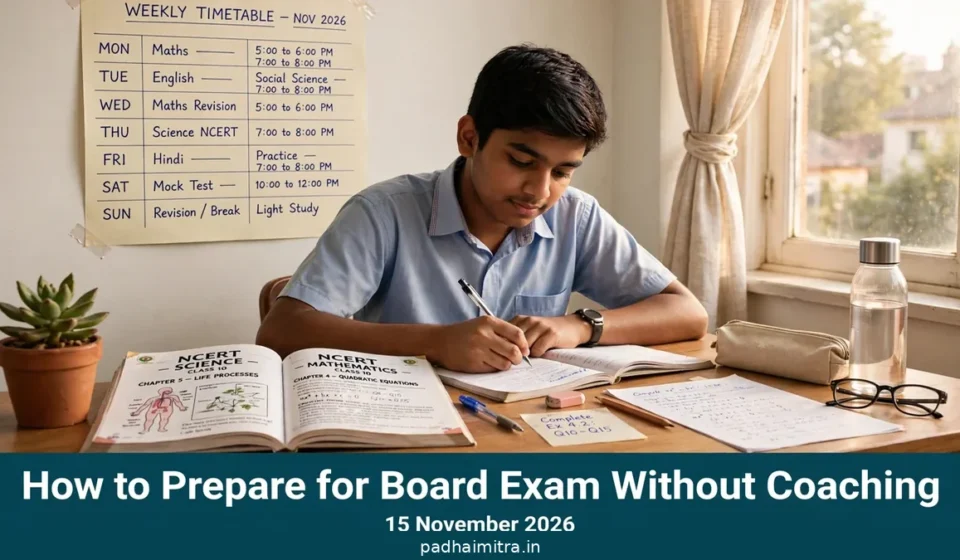

How to prepare for board exam without coaching — thousands of students ask it every year, and the honest answer is yes, it can be done. Coaching can organise your study, but it cannot study for you. The board paper is built on your prescribed textbook, previous year papers and the marking scheme — all free and available to you. What you need instead is a system: a daily plan you can follow, the right books, regular written practice, and a way to clear doubts. This guide gives you that system — it works for self study for board exam class 10 and class 12 both, without any expensive course. No 12-hour days, no shortcut — just steady work in the right order.
Follow it step by step, and you will see how to prepare for board exam without coaching is a matter of routine, not money.
How to Prepare for Board Exam Without Coaching — Start With a Plan You Can Follow
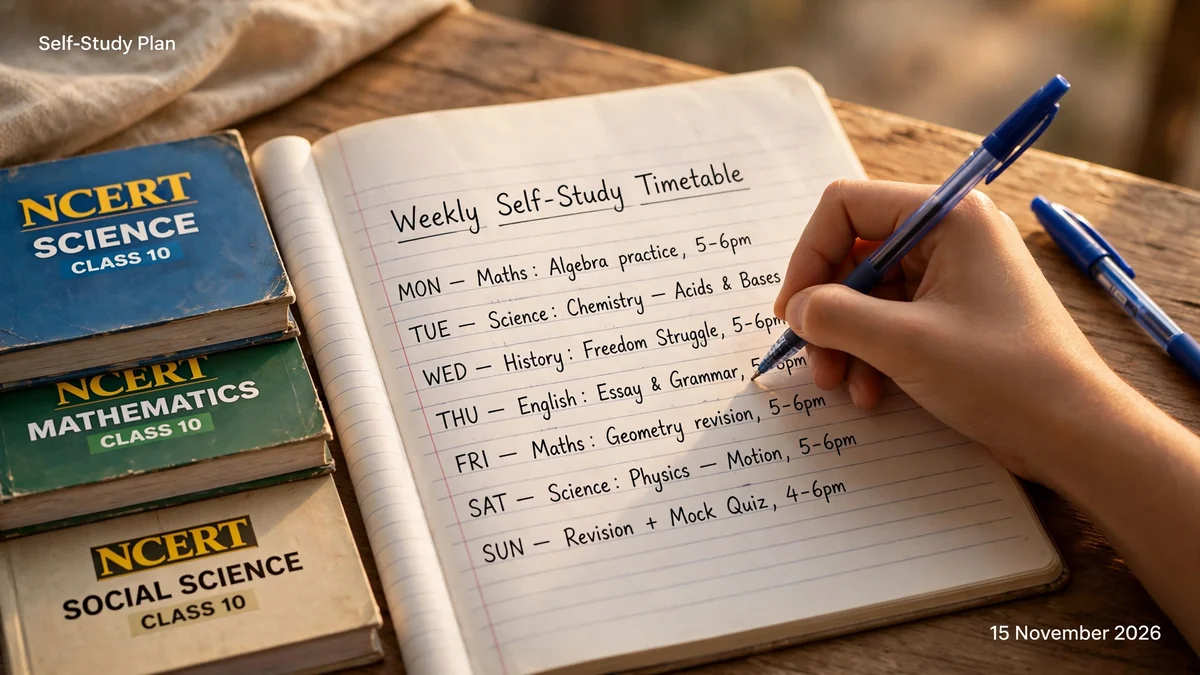
A self study plan for board exam works only if you can follow it every day. A plan needing 8 hours a day breaks in the first week — and a broken plan leaves you feeling behind. This one needs 4 to 5 focused hours after school, the same few habits repeating every week.
Start with an audit, not a timetable. Take one page per subject and divide the chapters into three lists: done and firm, done but weak, and not started. That page tells you where your hours should go — the weakest list gets the most time, not the favourite subject. Update it every Sunday — watching chapters move lists keeps you going.
Every day: study two subjects — one hard, one easy. Read the textbook, solve the exercises in writing, then close the book and recall the main points. Make short notes of 5–6 points per chapter — by the last month, those notes are what you revise from.
Every week: five days of new study plus short daily revision, one day for a full revision of the week’s chapters and one timed practice set, and one lighter day for rest. Revise a finished chapter the same evening, after three days, and after a week — a chapter read once in October is gone by February unless revised.
Every month: one full sample paper per subject under timed conditions; update your weak-chapters list from the results. In the final month, revise from notes and sample papers only — no new chapters.
| Day | Study (4–5 hours) | Why |
|---|---|---|
| Monday | Maths + English | Hardest first, energy highest |
| Tuesday | Science + Hindi / second language | New chapter, written practice |
| Wednesday | SST / Commerce / Arts subject + English | Reading, answers in writing |
| Thursday | Maths + Science | Numericals, diagrams from memory |
| Friday | Weakest subject + revision of the week | Weakest list gets its own day |
| Saturday | Full revision + one timed practice set | Recall, no new reading |
| Sunday | Light day — short notes, rest, plan next week | Rest is part of the plan |
Change the subjects to fit your stream and timetable; keep the shape — two subjects a day, written practice daily, and a weekly revision day that never moves. That is the whole answer to how to prepare for board exam at home: not a new book or app, but the same habits repeated for months.
Also read: How to Study Effectively for Exams
NCERT First — Your Main Teacher at Home
Without a coaching teacher, your textbook becomes your teacher — good news, because the paper is built around it. For CBSE, NCERT is the base: most questions come from its chapters, diagrams and exercises. For state boards, your board’s prescribed textbook plays the same role. Read the chapter first, solve the in-text questions and exercises in writing, then open a guide.
Many self-study students do the opposite: they buy four guides and never finish the textbook. Guides help with extra practice, but they cannot replace the book the paper is set from — one textbook, fully done, beats four half-read guides. After the textbook, the next step for Science and Maths is the NCERT Exemplar, with the tougher questions that separate 80 percent from 90.
That order — textbook first, Exemplar second — is the heart of how to prepare for board exam without coaching: the paper is set from the book, so the book comes first.
Keep a one-page formula sheet per subject, updated weekly — formulas and laws in Science, formulas with one example in Maths, a timeline or key terms in SST and Commerce. By the last month, that sheet is what you revise from, not the whole book again.
Previous Year Papers and Sample Papers — Free Practice That Shows the Pattern
Previous year papers show you what no guide can: which chapters repeat, which question types appear every year, and what each chapter is worth. Solve the last five years’ papers subject by subject and list the repeating chapters — those are your priority list. Your school library usually has them, and the board’s website publishes sample papers and marking schemes free.
Sample papers from the official board website show the current pattern and marking scheme. Solve one per subject every month, timed — three hours, no book, no phone — then analyse it: sort every lost mark into concept, rushed and time mistakes. Write each in a mistake diary with one small fix — “solve 10 questions of this chapter again” — and read it before the next paper. A paper you never analyse only rehearses your mistakes.
In the last two months, give one mock test every one or two weeks — subjects first, full papers at the end. The analysis matters more than the score: the papers tell you exactly where the next marks are hiding. The steps are in How to Analyse Mock Test Mistakes and Improve: Error Log Method.
Also read: One Month Revision Plan for Board Exam Class 10: A 4-Week Plan
Free Resources That Actually Help
Board exam preparation without coaching classes depends on good material, not expensive material. Everything below is free, and everything here is enough — do not collect ten sources for one subject; pick one from each row and stick to it.
| What you need | Free resource | Use it for |
|---|---|---|
| Textbook | NCERT textbook (ncert.nic.in) or your board’s book | First reading, exercises, diagrams |
| Extra practice | NCERT Exemplar (free on NCERT site) | Tougher questions after the textbook |
| Paper pattern | Board website sample papers + marking scheme | Timed practice, marking rules |
| Video explanations | NCERT / DIKSHA official videos | Only topics the book could not make clear |
| Doubt-clearing | School teacher, school library, a study group | Asking, discussing, checking |
| Revision | Your own short notes + previous year papers | Last-month revision, not new reading |
A note on videos: they help only for topics the book could not make clear. Watching three hours of videos a day is not studying — it is watching. Use a video for one stuck topic, then close it and solve the questions. And be careful with random “notes” PDFs and answer keys on social media: they often have wrong answers and old patterns. Trust your textbook, the board’s site and your teacher first.
How to Clear Doubts Without a Coaching Teacher
The hardest part of how to study for board exam by yourself is not the syllabus — it is the doubt that sits unanswered for weeks. In coaching you ask the teacher the same day; without coaching you need your own system, or doubts pile up and become weak chapters.
Keep a doubt notebook — one page per subject. Whenever you get stuck, write the question in one line and move on — do not stop the whole session for one doubt. The next day, take the notebook to school and ask your teacher — the most underused free resource. They know the paper and your level; a clear question gets a clear answer. Ask in class or after class; a teacher would rather answer ten questions than watch a student stay silent and lose marks.
A small study group helps too — two or three serious friends. Meet once a week with your doubt lists and solve them together. Explaining a topic to a friend is also the fastest test of whether you really know it: if you cannot explain it simply, you have not learned it yet. Between the teacher, the group and the solved examples, very few doubts survive a week. That is why students who ask how to prepare for board exam without coaching should build their doubt system first — it replaces the teacher’s daily answers. The rule is simple: no doubt older than a week.
Common Mistakes Self-Study Students Make
No written practice. Reading feels like studying, but board exams test writing — if you never practise in writing, the first time is in the exam hall. End every study block with something written.
Collecting too many books and PDFs. Five guides, three apps and twenty PDFs make preparation scattered, not better. One textbook, one question bank, one notebook; finish them.
No test, no check. Without coaching tests, many students never sit a timed paper before the board exam. The first timed paper should be at home, months before — not in the exam hall. If your mind goes blank in a paper, the steps are in What to Do When Your Mind Goes Blank in an Exam.
Comparing with coaching friends. A friend saying they finished the syllabus says nothing about how firm their preparation is. Your audit list is the only honest measure — compare this week with last week, not with anyone else.
Studying alone with no routine. Self-study fails most often not from lack of books but from lack of a fixed time — same place, same hours, every day. The routine is the teacher when there is no teacher.
Starting new topics in the last week. New chapters stay half-done and shake the rest. The last week is for short notes, the mistake diary and sleep — the 3-hour plan in What to Study the Night Before an Exam shows how.
Conclusion: How to prepare for board exam without coaching comes down to five habits: a daily plan you can follow, the textbook finished first, previous year papers solved and analysed, free resources used wisely, and no doubt older than a week. Coaching can organise these habits, but it cannot do them for you — the reading, writing and revision are yours either way. Start with the audit page today; study two subjects tomorrow and write something before you stop. That is the whole system — simple, free, and enough.
Frequently Asked Questions
Q: How to prepare for board exam without coaching in 3 months?
A: Three months is enough if the syllabus is mostly covered. First month: finish weak chapters, make short notes. Second: previous year papers, one sample paper per subject. Last: revision from notes only, with a mistake diary. Four to five focused hours a day is enough.
Q: Is NCERT enough for board exam preparation without coaching?
A: For CBSE, NCERT is the base of the paper — most questions come from it directly or indirectly — so yes, a complete NCERT with all exercises solved is the foundation. For state boards, your board’s prescribed textbook plays the same role. The Exemplar and previous year papers come after the textbook.
Q: How many hours should I study daily for self study?
A: For most students, 4 to 5 focused hours after school is enough, in 25–50 minute sessions with short breaks. More hours help only if the extra time is also focused — six distracted hours are worth less than four focused ones.
Q: What should I do when I get stuck on a topic and there is no teacher to ask?
A: Write it in your doubt notebook and move on. Ask your school teacher the next day, discuss it in your study group, or check the textbook’s solved examples. No doubt older than a week; anything older becomes a weak chapter.
Q: Can I score 90 percent without coaching?
A: Yes — the paper is built on the prescribed textbook and previous year papers, both free. What decides the score is steady work, not coaching: no weak subject, written practice daily, a revision cycle, and answers written the way the marking scheme rewards. No plan can promise 90 percent — the result depends on months of steady work.